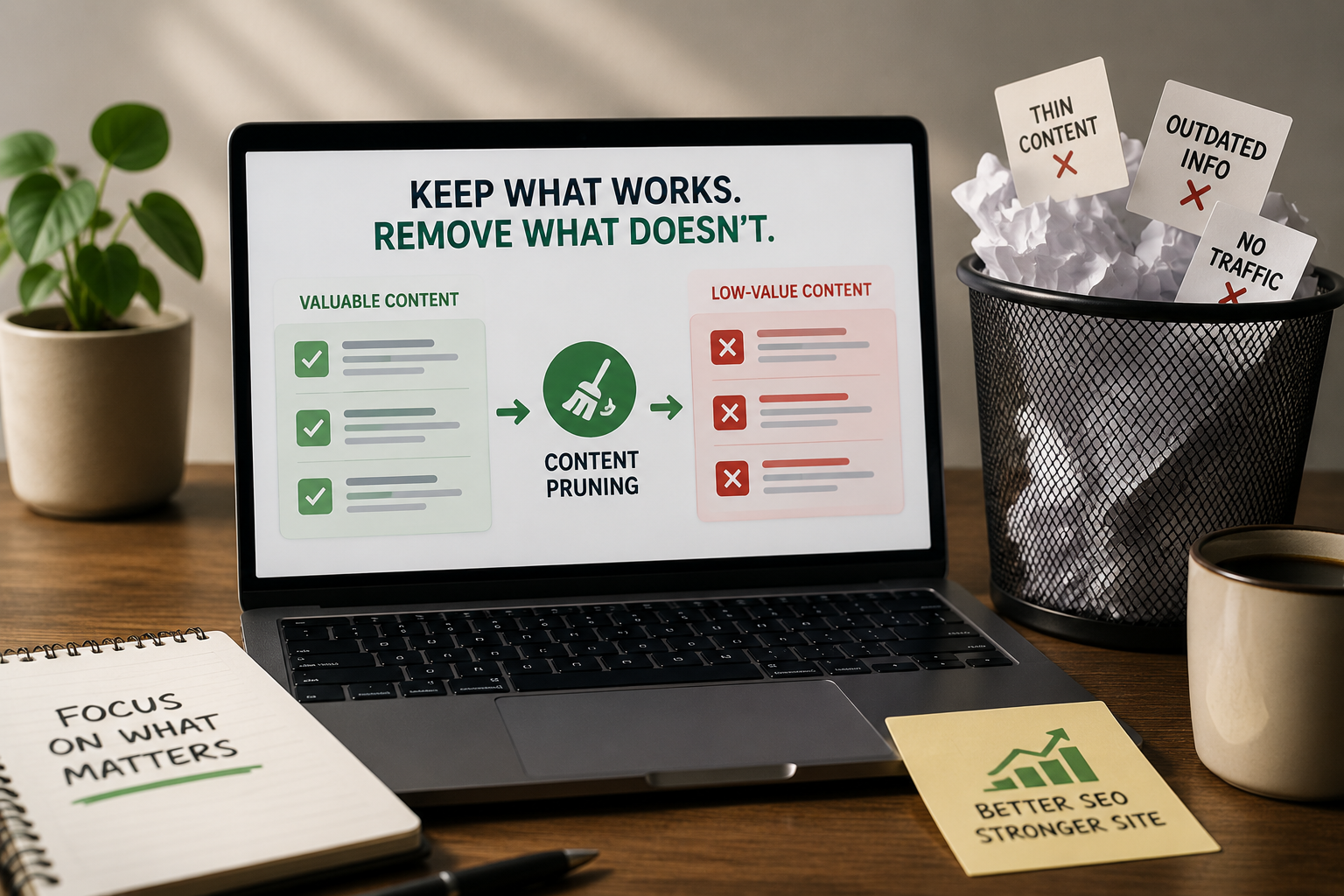
Many websites keep adding new pages, but rarely check whether old ones still help users or search performance. Over time, outdated blogs, thin pages, duplicate topics, and weak URLs can make a site harder to crawl, index, and understand. This is where content pruning becomes important.
It helps remove, merge, update, or redirect pages that no longer support your SEO goals. For businesses aiming to improve organic visibility and prepare for AI Overview results, a cleaner content structure matters. EMIAC Technologies helps companies identify weak content, fix keyword cannibalisation, and build stronger pages for modern search.
What Is Content Pruning?
Content pruning is the process of reviewing existing website pages and deciding what should stay, what should improve, and what should be removed.
For beginners, think of it as cleaning your website’s content library. You keep the useful pages, update the outdated ones, merge similar topics, and remove pages that no longer add value.
Content pruning may include:
- Updating old blogs
- Merging similar pages
- Redirecting outdated URLs
- Removing thin pages
- Improving important service pages
- Fixing duplicate topics
- Refreshing old information
- Cleaning internal links
- Improving search intent alignment
The purpose is not to delete content blindly.
The purpose is to make your website clearer, stronger, and more useful for readers. Google’s helpful content guidance also says its systems aim to prioritise helpful, reliable content created for people rather than content made mainly to manipulate rankings.
Why Content Pruning Matters for SEO
A website with too many weak pages can become difficult for users and search systems to understand.
Search engines do not need more pages from every website. They need better pages that answer search intent clearly.
Content pruning can support SEO by helping you:
- Improve overall content quality
- Remove outdated information
- Reduce duplicate pages
- Reduce keyword cannibalisation
- Improve crawling and indexing
- Make important pages easier to find
- Strengthen internal linking
- Improve user experience
- Build clearer topic authority
- Prepare content for AI SEO
Many businesses in India keep publishing blogs every month, but do not review older pages.
This creates a silent SEO problem.
A large blog section may look useful from the outside, but if many pages are outdated, thin, or overlapping, they may weaken the website’s structure.
How Content Pruning Supports AI Overview Ranking
AI Overview results are designed to give users quick summaries with supporting links. Google says pages need to be indexed and eligible to appear in Search with a snippet to be eligible as supporting links in AI Overviews or AI Mode. Google also says there are no extra technical requirements for AI features beyond standard Search eligibility.
This means no agency should promise a fixed AI Overview ranking.
However, content pruning can help build a better foundation for AI Overview visibility.
It can support AI SEO by:
- Removing weak pages that create clutter
- Improving pages that answer important queries
- Making key content easier to find
- Reducing repeated content
- Updating outdated sections
- Strengthening internal links
- Improving crawling and indexing
- Creating clearer topic clusters
EMIAC Technologies helps companies review weak content, improve useful pages, and build a cleaner website structure that can support organic search and AI-led discovery.
Content Pruning and Crawl Budget
Crawl budget is the set of URLs that search engines can and want to crawl on a website.
For small websites, crawl budget may not always be a major issue. For large websites, ecommerce websites, old blogs, and service websites with hundreds of URLs, it can matter more.
Google explains that if many known URLs are duplicates, unwanted, removed, or unimportant, crawling time can be wasted on those URLs. Google also recommends managing URL inventory, consolidating duplicate content, keeping sitemaps updated, and avoiding long redirect chains.
Content pruning can support crawl budget by helping search systems focus on pages that matter.
This may include:
- Removing outdated URLs
- Redirecting weak pages to better pages
- Consolidating duplicate content
- Fixing soft 404 issues
- Cleaning sitemap entries
- Reducing unnecessary indexable pages
- Updating low-value content
- Improving internal links to important pages
For Indian businesses with long-running blogs, this can be very useful.
Old posts may no longer match your services, customer needs, or current search behaviour. Pruning helps bring focus back to the pages that matter.
Content Pruning and Crawling And Indexing
Crawling and indexing are not the same.
Crawling means a search engine discovers and visits a page.
Indexing means the page is stored and considered for search results.
A page can be crawled but not indexed. A page can also be indexed but perform poorly because it is weak, outdated, or too similar to another page.
Content pruning helps improve crawling and indexing by making the website cleaner.
It can identify:
- Pages discovered but not indexed
- Crawled pages with little search value
- Duplicate or near-duplicate pages
- Thin pages with limited useful information
- Outdated blogs
- Old campaign pages
- Pages blocked incorrectly
- URLs that should be redirected
- Important pages with weak internal links
Google’s AI feature guidance also recommends making content easily findable through internal links and making sure important content is available in textual form.
That is why content pruning is not only about removal.
It is also about improving the way search systems and users move through your website.
What Is Keyword Cannibalisation?
Keyword Cannibalisation happens when multiple pages on the same website compete for the same or very similar search intent.
This often happens when a website has published many blogs around the same topic without a clear content plan.
For example, a business may have several old pages targeting the same service, the same question, or the same keyword variation. Instead of one strong page, the website ends up with many weaker pages.
Keyword cannibalisation may happen when:
- Several blogs target the same query
- Old and new pages cover the same intent
- Service pages and blogs compete
- Location pages repeat the same content
- Category pages and articles overlap
- Thin pages are created for small keyword variations
Content pruning helps fix this by:
- Choosing the strongest page
- Merging useful information
- Redirecting weaker pages
- Rewriting pages for a different intent
- Improving internal links
- Updating the main page
- Removing unnecessary overlap
This makes the website easier to understand.
It also helps users land on the most useful page instead of reaching a weaker version of the same topic.
Signs Your Website Needs Content Pruning
Many websites need content pruning, but do not realise it.
A website may look active because new pages are being published. But activity is not the same as quality.
Your website may need content pruning if it has:
- Old blogs with no traffic
- Pages that are not indexed
- Several pages on the same topic
- Outdated service information
- Thin content with little value
- Duplicate titles or headings
- Weak internal linking
- Broken links
- Old URLs are still present in the sitemap
- Pages with no business relevance
- Search visibility spread across similar pages
- Blogs that do not connect to service pages
These issues are common in service-based websites.
Many businesses invest in new content but ignore the health of existing pages. That can make SEO harder over time.
How EMIAC Technologies Helps with Content Pruning
EMIAC Technologies helps companies handle content pruning with a structured SEO process.
The aim is not to remove pages randomly. The aim is to improve website quality, search clarity, and AI Overview readiness.
EMIAC Technologies can help your company with:
- Full website content audit
- Search performance review
- Indexing status check
- Crawl issue review
- Keyword cannibalisation mapping
- Internal link audit
- Sitemap review
- Content quality scoring
- Page update recommendations
- Redirect planning
- AI SEO content improvement
- Post-pruning performance tracking
This gives your company a clear view of what needs to be kept, improved, merged, redirected, or removed.
It also reduces the risk of making SEO changes without proper data.
Step One: Audit Existing Website Content
The first step is to understand what is already published on your website.
Many companies do not have a clear view of how many pages are live, which pages are indexed, which pages bring traffic, and which pages add no real value.
A content audit may review:
- Page URL
- Page title
- Meta title
- Search intent
- Organic clicks
- Organic impressions
- Average position
- Indexing status
- Internal links
- Backlinks
- Content freshness
- Duplicate topics
- Business relevance
This helps separate useful pages from weak pages.
It also helps EMIAC Technologies find pages that may need rewriting, merging, redirection, or removal.
Step Two: Group Pages by Action
After the audit, each page should be placed into a clear action group.
This avoids guesswork.
Common action groups include:
- Keep
- Update
- Merge
- Redirect
- Noindex
- Remove
- Repurpose
Each action has a different role.
A strong page may only need minor updates. A weak but relevant page may need rewriting. A duplicate page may need to be merged. A page with no value may need removal or redirection.
This step is important because removing the wrong page can affect traffic, internal links, and conversions.
Content pruning should be handled carefully, especially for websites with many indexed pages.
Step Three: Improve Pages That Still Have Value
Not every weak page should be removed.
Some pages have potential but need better structure, stronger information, or clearer intent.
EMIAC Technologies may improve such pages by:
- Rewriting unclear sections
- Adding missing information
- Improving headings
- Updating old information
- Removing repeated text
- Matching content with search intent
- Adding useful internal links
- Improving calls to action
- Making answers more direct
- Improving readability for Indian audiences
This is especially useful for pages with impressions but low clicks.
If a page is already appearing in search but not performing well, improving it may be better than deleting it.
Step Four: Merge Similar Pages
When two or more pages answer the same query, merging may be the right move.
This is common on websites that have been publishing blogs for several years.
Instead of letting many weak pages compete, EMIAC Technologies can help create one stronger page that covers the topic properly.
The merging process may include:
- Choosing the strongest URL
- Moving useful content from weaker pages
- Removing repeated sections
- Creating a cleaner page structure
- Updating headings
- Adding internal links
- Redirecting old URLs
- Updating the sitemap
This can help reduce Keyword Cannibalization.
It also gives users a better reading experience because they get one complete page instead of scattered information across several URLs.
Step Five: Remove or Redirect Low-Value Pages
Some pages no longer serve any useful purpose.
They may be outdated, thin, irrelevant, duplicated, or disconnected from current business goals.
Before removing a page, EMIAC Technologies checks whether it has:
- Organic traffic
- Backlinks
- Internal link value
- Conversion value
- Service relevance
- Useful information that can be reused
- Historical importance for the business
If a page has value, it may be updated or redirected.
If it has no clear value, it may be removed.
This decision should be based on data and judgement, not assumptions.
Step Six: Fix Internal Links and Sitemap Issues
After pruning, internal links and sitemap entries need attention.
If deleted pages are still linked across the website, users may reach broken URLs. If outdated URLs remain in the sitemap, crawling may stay inefficient.
Google says links are used as a signal for page relevance and to discover new pages. It also recommends crawlable links and descriptive anchor text so users and Google can understand linked content more easily.
EMIAC Technologies may check:
- Broken internal links
- Links pointing to redirected pages
- Old URLs in the sitemap
- Redirect chains
- Important pages with too few links
- Blog links pointing to outdated services
- Navigation links that need clean-up
- Anchor text that is too generic
Internal linking is important after content pruning because the website structure changes.
The cleaned-up site should guide users towards the strongest and most useful pages.
Step Seven: Request Reindexing Where Required
After major content updates, Google may need time to revisit the page.
Google’s URL Inspection tool allows site owners to inspect a URL, test whether it may be indexable, and request indexing for a URL. Google also notes that requesting indexing does not guarantee that a page will appear in the index.
Reindexing may be useful after:
- Major content updates
- Redirect changes
- Internal link fixes
- Sitemap updates
- Important page refreshes
- Technical fixes
- Merged content updates
This step should be used carefully.
It is not a shortcut to rankings. It simply helps search systems revisit updated pages.
Content Pruning for AI SEO
AI SEO focuses on making content suitable for both regular search and AI-led search experiences.
Content pruning supports AI SEO because it removes confusion from the website.
If a site has too many similar, outdated, or thin pages, it can be harder to understand which page gives the best answer.
Content pruning can support AI SEO by:
- Keeping useful pages visible
- Improving direct answers
- Removing outdated information
- Reducing duplicate intent
- Strengthening internal links
- Improving page quality
- Supporting topic clarity
- Making service pages easier to understand
- Preparing pages for AI Overview eligibility
Google’s AI feature guidance says the same SEO best practices remain useful for AI features, including allowing crawling, using internal links, offering a good page experience, and keeping important content in textual form.
This is why content pruning is a good first step before creating more AI SEO content.
A cleaner website gives future content a stronger base.
Why New Content Alone Is Not Enough
Many businesses try to fix SEO by publishing more blogs.
New content can be useful, but only when the existing content base is healthy.
If your website already has many weak or repeated pages, adding more blogs may create more clutter.
Before publishing a new page, ask:
- Do we already have content on this topic?
- Is the existing page outdated?
- Is another page targeting the same intent?
- Can an old page be improved instead?
- Does the topic support our service goals?
- Will the page help users make a better decision?
- Can this page be connected to a service page?
Content pruning helps businesses make smarter publishing decisions.
It shifts the focus from content volume to content value.
How Content Pruning Helps Indian Service Businesses
Indian service buyers often research before making an enquiry.
They compare providers, read blogs, check service pages, and look for clear answers. If your website is full of outdated or repeated content, it can weaken trust.
Content pruning helps service-based businesses by:
- Connecting blogs to service pages
- Removing outdated topics
- Updating old explanations
- Improving enquiry-focused pages
- Reducing content overlap
- Making the website easier to navigate
- Supporting better search intent alignment
- Improving content quality for decision-makers
For companies offering services in competitive sectors, this can be very useful.
A cleaner website can make your expertise easier to understand.
What Businesses Should Avoid during Content Pruning
Content pruning should never be rushed.
Wrong pruning decisions can affect traffic, leads, and user experience.
Avoid these mistakes:
- Deleting pages without data
- Removing pages with useful backlinks
- Ignoring redirects
- Keeping outdated URLs in the sitemap
- Pruning only based on traffic
- Ignoring business relevance
- Removing pages that support conversions
- Forgetting keyword cannibalisation
- Using noindex without proper review
- Making changes without tracking results
- Removing content only because it is old
Age alone does not make content weak.
Some old pages may still bring qualified traffic or support important customer decisions. Such pages may need updates, not removal.
How EMIAC Technologies Builds a Content Pruning Plan
EMIAC Technologies builds a content pruning plan around SEO data, business goals, search intent, and AI SEO readiness.
The process is designed for both audiences:
- Readers who are new to content pruning
- Companies are looking for an SEO team to handle the work
The plan may include:
- Website content audit
- Search Console review
- Crawl data review
- Indexing check
- Keyword cannibalisation mapping
- Content quality review
- Internal link review
- Sitemap clean-up
- Redirect planning
- Content refresh plan
- AI Overview readiness review
- Post-pruning tracking
This gives your company a clear roadmap.
It also prevents random SEO changes that may create more issues than they solve.
How to Measure Content Pruning Results
Content pruning should be measured over time.
Search systems may take time to crawl, index, and reassess updated pages.
Useful areas to monitor include:
- Organic impressions
- Organic clicks
- Average position
- Indexed pages
- Crawl errors
- Duplicate page issues
- Keyword cannibalisation changes
- Engagement on updated pages
- Service page visibility
- AI Overview: appearance checks
- Enquiry quality
Google says sites appearing in AI features such as AI Overviews and AI Mode are included in overall Search Console performance reporting under the Web search type.
This makes Search Console a useful place to review broad search performance after pruning.
Why EMIAC Technologies Can Help Your Company
Content pruning needs more than a simple list of pages.
It needs SEO knowledge, content judgement, technical review, and a clear understanding of user intent.
EMIAC Technologies can help your company by:
- Finding weak and outdated content
- Improving pages with search potential
- Fixing crawling and indexing issues
- Reducing keyword cannibalisation
- Cleaning internal links
- Updating important service pages
- Building stronger content clusters
- Improving AI SEO readiness
- Tracking performance after changes
The aim is not to promise fixed AI Overview rankings.
The aim is to improve the quality and clarity of your website so that users, search engines, and AI-led search systems can understand it better.
Final Thoughts
Content pruning is one of the most ignored SEO fixes, but it can make a website cleaner, sharper, and easier to understand.
For beginners, the idea is simple. Keep useful content, update pages with potential, merge overlapping topics, and remove pages that no longer support users or business goals.
For businesses looking for this service, content pruning should be handled with care. It requires SEO data, technical checks, content review, internal linking improvements, and proper crawling and indexing decisions.
EMIAC Technologies helps companies clean weak content, fix Keyword Cannibalization, improve crawl budget use, strengthen important pages, and prepare websites for better organic and AI Overview visibility.
No agency can guarantee the AI Overview ranking. But with a cleaner website, stronger content, and better structure, your company can build a more reliable foundation for modern search.