AI search is changing the way people find information online. Users are not only checking regular search results anymore. They are also reading AI-generated answers, quick summaries, comparison-style responses, and conversational results before making a decision.
This is where LLMO, or Large Language Model Optimisation, becomes important.
LLMO focuses on making your website, content, and brand easier for AI systems to understand, trust, and reference. It works with traditional SEO, not against it. The difference is that the goal is no longer limited to ranking on search pages. Brands also want to improve AI visibility, LLM visibility, and the chances of being considered in AI-led responses.
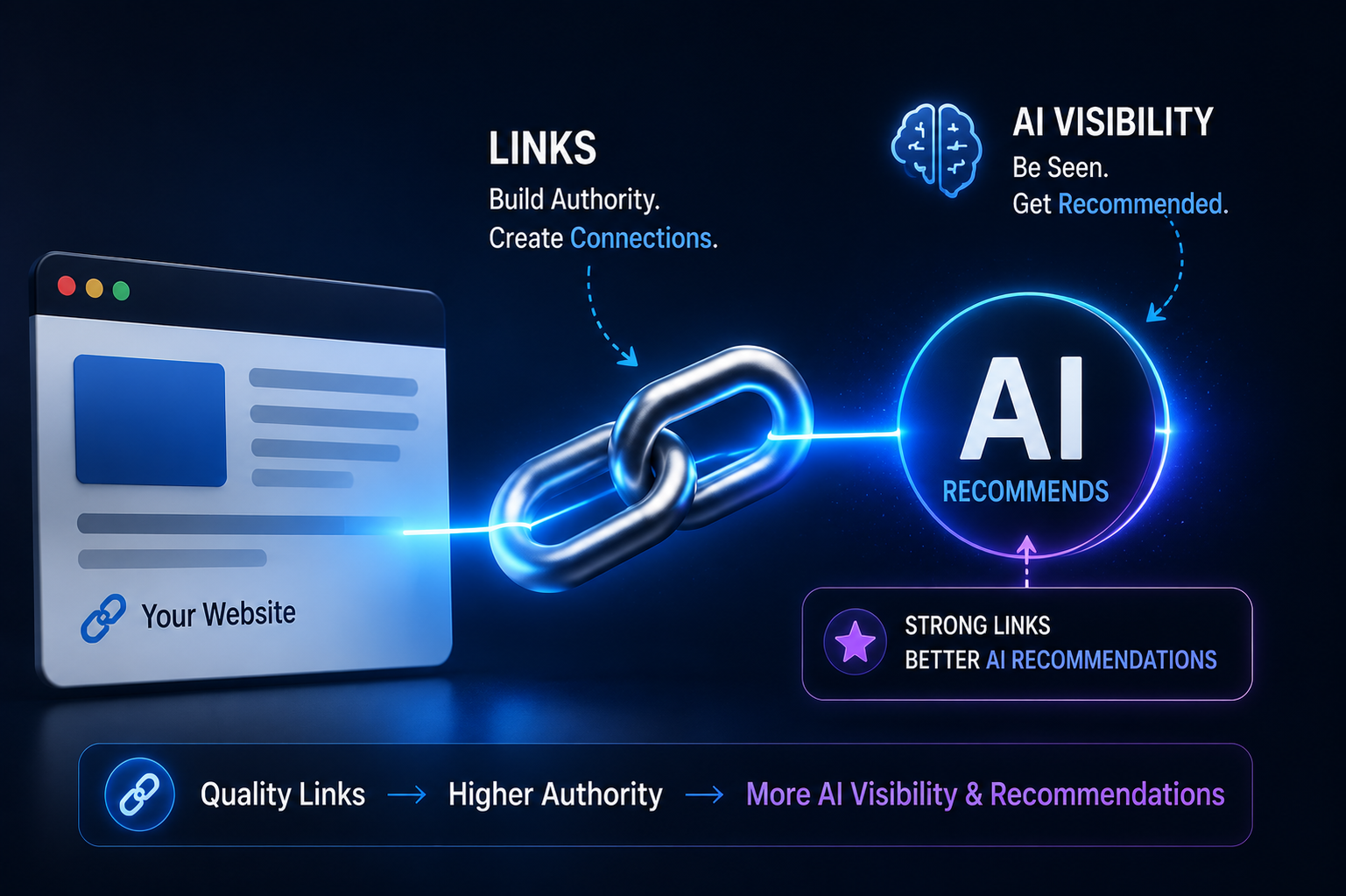
Links play a major role in this process.
A well-planned link strategy can connect your content with relevant topics, trusted sources, and useful pages. It can also support off-page SEO, brand mentions, and AI citations when done correctly. Google’s own search documentation explains that crawlable links and clear anchor text can help search systems discover pages and understand the relevance of linked content.
For Indian businesses, this matters because buyers often research deeply before they enquire. They compare agencies, read service pages, check credibility, and look for clear answers. If your website is structured well and supported by meaningful links, it can become easier for both users and AI-led systems to understand what your business does.
What Is LLMO?
LLMO is the process of improving how your brand and content appear across AI-led search experiences.
You may also see related terms such as LLM optimisation, AI SEO, GEO, and AEO. These terms are often used in similar contexts because they all focus on how brands can become more visible in AI-based answers and answer-led search experiences. The reference article also explains that LLMO builds on SEO foundations such as content quality, topical authority, brand mentions, and links.
In simple terms, LLMO is about making your content:
- Easier to understand
- Easier to connect with a topic
- Easier to verify through trusted signals
- Easier to summarise
- Easier to associate with a service or industry
It is not about stuffing keywords into content.
It is not about writing for machines only.
It is about creating clear, useful, and well-connected content that serves readers first and gives AI systems better context.
How LLMO Is Different from Traditional SEO
LLMO and traditional SEO are closely linked, but they do not work in the same way.
Traditional SEO focuses on improving website visibility in search engine results. It usually includes keyword research, technical SEO, content quality, page structure, internal links, backlinks, and user experience.
LLMO adds another layer.
It looks at how your brand may appear in AI-generated answers, AI search summaries, conversational responses, and answer-led search results.
The core difference is the visibility point.
Traditional SEO often focuses on:
- Ranking pages
- Increasing organic traffic
- Improving keyword visibility
- Building backlinks
- Optimising search snippets
LLMO focuses on:
- Improving brand relevance in AI-led answers
- Making content easier to summarise
- Building topic authority
- Earning relevant brand mentions
- Supporting AI citations
- Connecting pages through meaningful links
- Strengthening trust signals across the web
This does not mean SEO is becoming less useful. In fact, strong SEO foundations can support LLMO because AI search systems often depend on clear, reliable, and accessible web content.
Why AI Visibility Matters for Indian Businesses
AI visibility matters because search behaviour is becoming more answer-led.
Many Indian users now want quick clarity before they speak to a business. They may want to know what a service means, how it works, who offers it, and whether a company looks credible enough to contact.
This is important for service-based businesses because buying decisions often depend on trust.
A business may need AI visibility when it wants to:
- Be found for service-related searches
- Improve visibility across informational queries
- Build authority around a niche
- Support lead generation through organic visibility
- Be considered by users when comparing agencies
- Make its expertise easier to understand
For someone new to LLMO, the concept may sound technical. But at its heart, it is simple.
If your website clearly explains your services, connects related pages, earns relevant mentions, and builds trust through useful content, it becomes easier to understand.
That clarity is useful for users, search engines, and AI-led discovery.
Why Links Are Important in LLMO
Links help organise information.
They show how one page connects to another. They also help users move from a broad topic to a deeper explanation. Search systems use links to discover pages and understand relationships between pages.
For LLMO, links can support three important areas:
- Discovery: Helping important pages become easier to find
- Context: Showing how topics, services, and resources are connected
- Trust: Supporting credibility through relevant internal and external references
A link should not be added only because it contains a keyword.
It should make sense for the reader.
A useful link should:
- Explain the next step clearly
- Connect to a relevant page
- Fit naturally in the sentence
- Support the topic
- Improve the reading experience
This is where link building becomes important. However, link building for LLMO should be more careful than old-style backlink work. It should focus on relevance, quality, and context.
Internal Links and LLM Visibility
Internal links are links between pages on the same website.
They help your website work like a connected knowledge base. This is important for LLM visibility because isolated pages can be harder to understand in a broader topic structure.
For example, a website offering AI SEO or LLMO services may have pages around:
- SEO services
- Link building
- Content strategy
- Digital PR
- Technical SEO
- AI search optimisation
- Brand visibility
- Website authority
These pages should not sit separately without connection.
Internal links can connect them in a way that feels natural to readers.
A strong internal linking structure can:
- Guide users from blogs to service pages
- Help readers understand related topics
- Support topic clusters
- Reduce page isolation
- Make important pages easier to access
- Clarify service relevance
- Improve website structure
The best internal links are simple and helpful.
They do not interrupt the flow. They guide the reader at the right point.
External Links and Off-Page SEO
External links are links from other websites to your website.
They are often part of off-page SEO because they happen outside your own website. In LLMO, external links and brand mentions may support how your business is understood across the web.
This does not mean every external link is useful.
A strong external link usually comes from a relevant website, a meaningful article, or a context where your brand genuinely fits. A weak link may come from an unrelated source or content created only for backlink placement.
For LLMO, quality matters more than quantity.
Good external link work should focus on:
- Relevant industry websites
- Useful editorial placements
- Clear topic connection
- Natural anchor text
- Human-written content
- Trustworthy page context
- Brand mentions that make sense
- Content that adds value to the reader
Google’s spam policies caution against manipulative practices designed mainly to influence search results, so link building should remain ethical, useful, and reader-first.
What Are AI Citations?
AI citations are references or source mentions that appear in AI-generated answers.
When AI-led search tools provide an answer, they may refer to online sources, pages, brands, or articles that support the response. For businesses, this can create another visibility layer beyond standard search results.
AI citations are not something any agency can responsibly promise.
They depend on many factors, including content quality, page relevance, source trust, topic clarity, and how AI systems process information.
However, businesses can work towards stronger AI citation potential by improving:
- Content clarity
- Topical authority
- Internal linking
- External mentions
- Structured information
- Author and business credibility
- Freshness of important pages
- Relevance of backlinks
- Overall website quality
The aim is not to manipulate AI systems.
The aim is to make your brand and content easier to understand, evaluate, and reference.
Why Relevance Matters More than Link Volume
Old link building often focused too much on numbers.
Modern LLMO needs a more careful approach. A large number of unrelated links may not support real authority. It can also create mixed signals about what your website is actually about.
Relevance is more useful.
A relevant link connects your brand to the right service, topic, industry, or audience need.
This matters because AI-led systems work around intent. They try to understand what the user is asking and which sources may answer that query clearly.
A relevant link strategy should focus on:
- Pages that match your service category
- Content that relates to user intent
- Anchor text that reads naturally
- Websites that make sense for your niche
- Topics that support your expertise
- Mentions that feel editorial, not forced
For Indian businesses, this is especially important. Buyers may compare several providers before reaching out. A relevant digital presence can support that trust-building journey.
The Role of Anchor Text in LLMO
Anchor text is the clickable text used in a link.
It tells the reader what to expect when they click. It also gives search systems context about the linked page. Google’s link guidance recommends clear and descriptive anchor text because it can support understanding for both users and search systems.
For LLMO, anchor text should be natural.
It should not be overloaded with exact keywords such as AI SEO, LLM optimisation, or link building in every sentence.
Good anchor text should be:
- Clear
- Relevant
- Specific
- Easy to read
- Connected to the linked page
- Useful within the sentence
Avoid anchor text that is:
- Repetitive
- Over-optimised
- Misleading
- Too generic
- Forced into the content
A balanced anchor text profile looks more natural. It also keeps the content useful for readers.
How Link Building Supports AI SEO
AI SEO is about preparing your website for both search engines and AI-led discovery.
Links support AI SEO because they connect your website to relevant topics and trusted information paths.
A link-led AI SEO approach may include:
- Improving internal links between related pages
- Connecting blog content with service pages
- Earning mentions on relevant external websites
- Building topic clusters
- Updating older pages with better links
- Removing broken or irrelevant links
- Creating content that deserves references
- Using natural anchor text
This type of work should not be rushed.
LLMO is not a shortcut. It needs a steady content and link strategy that builds trust over time.
For agencies offering LLMO services, this is where strategic planning matters. The work is not only about getting backlinks. It is about understanding search intent, content gaps, brand positioning, and how links support the full digital journey.
What to Look for in an LLMO Agency
Businesses searching for an LLMO agency should look beyond basic backlink promises.
An effective agency should understand both content and links. It should also know how LLMO connects with traditional SEO, AI SEO, GEO, AEO, and off-page SEO.
Before choosing an agency, look for clarity in how they approach:
- Content structure
- Keyword selection
- Internal linking
- Link building
- Brand mentions
- Technical SEO
- Topic authority
- AI visibility tracking
- Reporting
- Long-term strategy
A good agency should not make fixed promises around AI citations or rankings.
Instead, it should explain the process clearly and focus on improving the quality, relevance, and structure of your digital presence.
For a business, that means asking practical questions:
- Does the agency understand your audience?
- Does it explain LLMO in simple terms?
- Does it avoid risky link practices?
- Does it focus on content quality?
- Does it build links from relevant sources?
- Does it connect LLMO with broader SEO goals?
- Does it give clear reporting without exaggeration?
EMIAC Technologies works with this kind of practical, service-led approach, where LLMO is treated as part of a wider digital visibility strategy rather than a quick backlink activity.
How EMIAC Technologies Approaches LLMO through Links
A strong LLMO strategy needs planning before execution.
For a business website, the first step is not to build links immediately. The first step is to understand what the website already says, how pages are connected, and where visibility gaps exist.
A practical LLMO link approach may include:
- Reviewing the current website structure
- Checking important service pages
- Mapping relevant topics
- Identifying content gaps
- Improving internal links
- Reviewing existing backlinks
- Finding relevant external link opportunities
- Strengthening brand mentions
- Creating helpful content assets
- Monitoring visibility direction over time
This type of approach keeps the work grounded.
It avoids random link building and focuses on links that support business relevance.
For companies in India, this can be useful because competition is high in many service categories. A business needs clear content, strong trust signals, and a website structure that helps users understand the service quickly.
Content Quality Comes before Links
Links work better when the content is strong.
If a page is thin, vague, or difficult to read, links alone cannot make it useful. LLMO needs content that answers the reader’s question clearly.
Google’s helpful content guidance encourages content that is created for people first, demonstrates expertise, and gives readers useful information rather than content created mainly to attract search traffic.
Strong LLMO content should be:
- Easy to understand
- Written by someone who understands the topic
- Structured with clear headings
- Focused on user intent
- Free from keyword stuffing
- Original in approach
- Supported by useful links
- Updated when needed
- Relevant to the service
This is why human-led content matters.
Readers should feel that the page was written by someone who understands the subject, not by someone trying to fill space with keywords.
The Link between Brand Mentions and LLM Visibility
Links are important, but brand mentions also matter.
A brand mention is when another website talks about your business, service, or expertise. Sometimes it includes a link. Sometimes it does not.
For LLM visibility, brand mentions may support wider recognition because they help create a clearer digital footprint.
Useful brand mentions may come from:
- Industry websites
- Business articles
- Service-related content
- Guest contributions
- Digital PR activity
- Local business references
- Knowledge-led articles
- Relevant online discussions
The focus should always be relevance.
A mention should make sense in the content. It should connect your business to the right topic, not appear randomly.
For Indian businesses, this can support trust because customers often check more than one source before making an enquiry.
Common LLMO Link Mistakes to Avoid
LLMO is still new for many businesses, so mistakes are common.
The biggest mistake is treating it as another name for aggressive link building.
Avoid these practices:
- Building links from unrelated websites
- Using the same anchor text repeatedly
- Publishing low-quality guest posts
- Adding links where they do not help the reader
- Ignoring internal linking
- Creating content only for keywords
- Making fixed AI visibility claims
- Treating AI citations as guaranteed
- Copying competitor content structure
- Forgetting technical SEO basics
A better approach is slower but cleaner.
Every page should have a purpose. Every link should support the topic. Every external placement should add context or credibility.
How to Measure LLMO Progress Sensibly
LLMO should be measured carefully because AI-led visibility is still evolving.
Instead of looking for instant outcomes, businesses should track signals that show whether the website is becoming clearer, stronger, and more discoverable.
Useful areas to review include:
- Organic visibility for relevant topics
- Growth in service-related impressions
- Improvements in internal linking
- Quality of external mentions
- Brand search movement
- Referral traffic from relevant websites
- Engagement on educational content
- Visibility across answer-led search experiences
- Better structure across topic clusters
These signals do not guarantee AI citations, but they can show whether the overall digital visibility system is improving.
This is the responsible way to approach LLMO.
Final Thoughts
LLMO is not a replacement for SEO. It is a natural extension of how search is changing.
People still need useful content. Search systems still need a clear website structure. AI-led answers still depend on reliable, understandable information. Links sit at the centre of this because they connect pages, topics, sources, and brand signals.
For businesses that are new to LLMO, the first step is simple: make your website clearer, more useful, and better connected.
For businesses searching for an LLMO agency, the priority should be finding a partner that understands content, links, AI SEO, off-page SEO, and long-term digital visibility.
A strong LLMO link strategy does not chase shortcuts. It builds relevance patiently through helpful content, natural links, trusted mentions, and a clear website structure.
That is how links can support AI visibility in a practical, ethical, and business-focused way.